
Day 9: The Only 5 Stack Patterns You Need for DSA Interviews
Matching, Monotonic, Expression, Augmented, Simulation

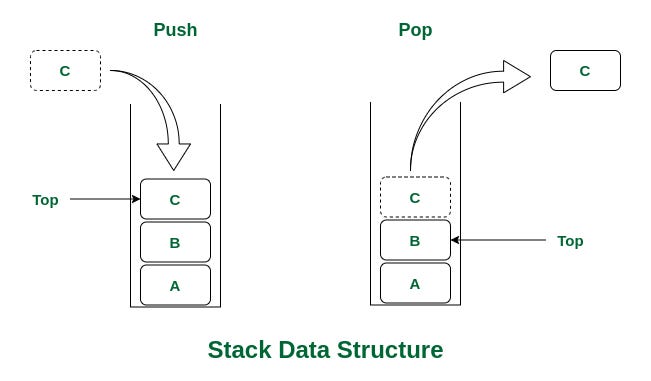
In DSA, Stack is an unavoidable data structure because from Operating System to JavaScript, everything runs on stack concepts.
Stack is very simple.
You insert a value, and you take out a value. That’s it.
But there is one strict rule → when you take a value, only the last inserted value will come out.
This is called First In Last Out (FILO).
Even though the operations are simple, stack problems are not random.
Almost all stack problems follow some fixed patterns.
There are 5 important stack patterns:
Matching
Monotonic
Expression
Augmented
Simulation
We will see them one by one.
1. Matching
The matching pattern is used when one element depends on another element and they must form a valid pair.
For example, take LeetCode problem Valid Parentheses:
https://leetcode.com/problems/valid-parentheses/
The problem is simple:
you want to check whether the given parentheses string is valid or not.
The string can contain:
(){}[]
A parentheses string is valid only if:
every opening bracket has a matching closing bracket
brackets are closed in the correct order
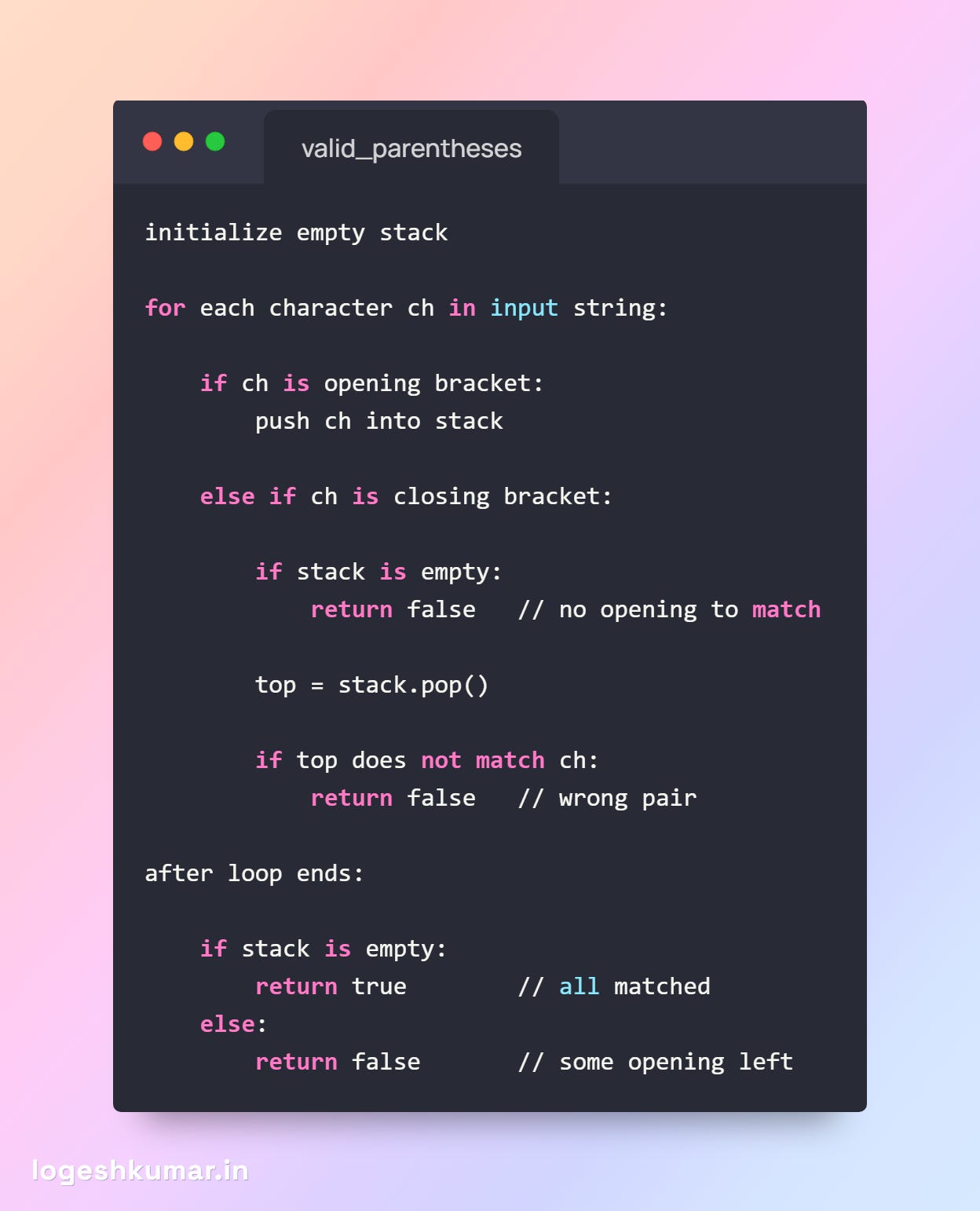
We use stack.
If we see an opening bracket, push it into the stack
If we see a closing bracket:
stack should not be empty
top of stack must be the same type
then pop it
If at any point:
stack is empty and we get a closing bracket → invalid
closing bracket doesn’t match the top → invalid
After processing the entire string:
if stack is empty → valid
else → invalid
2. Monotonic Stack
The Monotonic Stack pattern is used when you need to compare elements with previous or next elements and maintain a specific order inside the stack.
“Monotonic” simply means:
values in stack are always increasing
orvalues in stack are always decreasing
No randomness allowed.
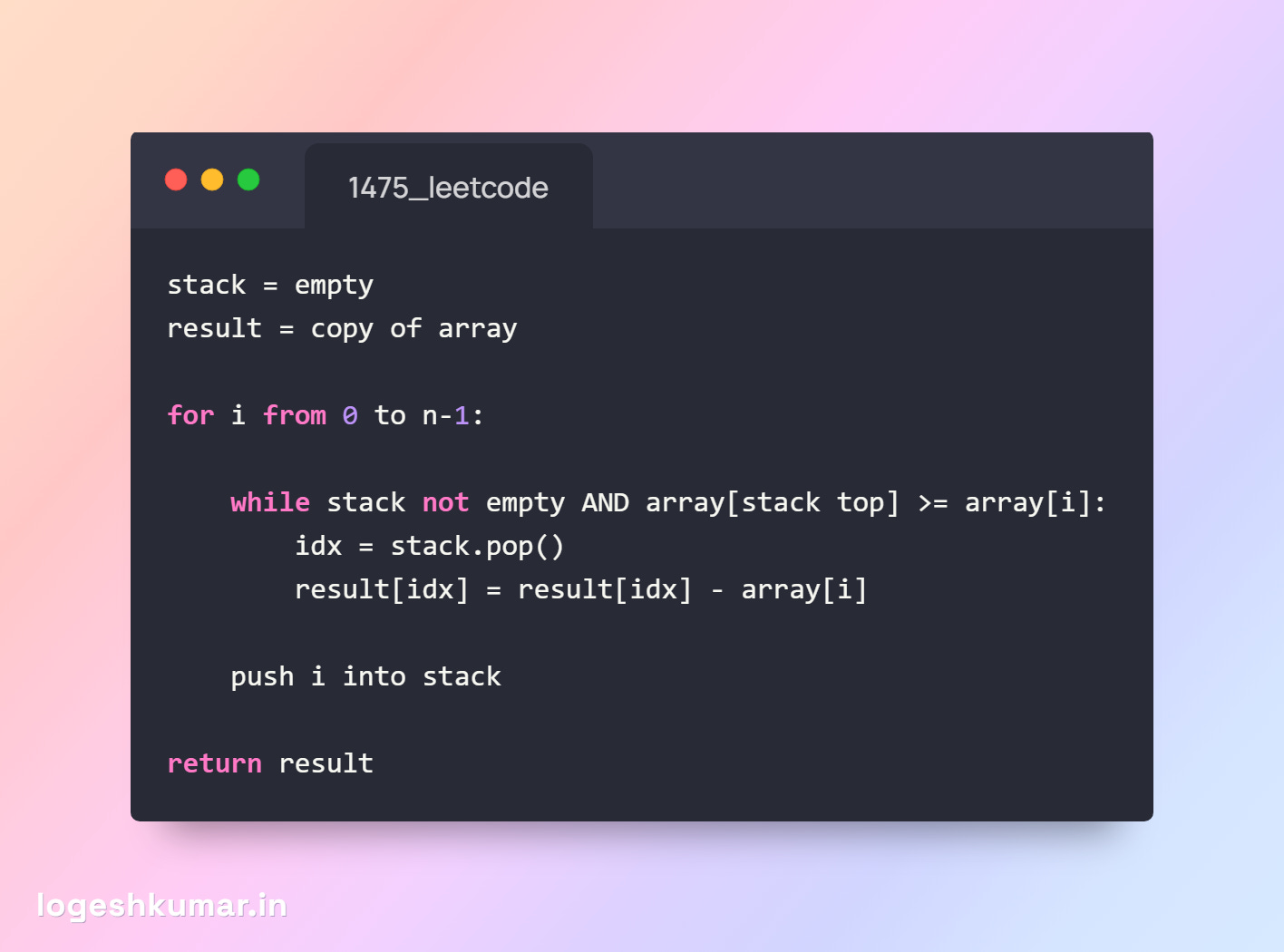
Simple Rule (Memorize This) [Increasing Monotonic Stack]
Go from left to right
Keep numbers in stack
If current number is Smaller than stack top:
pop Bigger ones until the stack becomes current number > stack top
assign answer to them
Push current number
Repeat.
Let’s take LeetCode 1475 – Final Prices With a Special Discount in a Shop
https://leetcode.com/problems/final-prices-with-a-special-discount-in-a-shop/
Here, we want to find the next smallest (or equal) value for every price.
Because we are searching for the next smaller element on the right,
we need a Monotonic Increasing Stack
General Monotonic Stack Rule (This Is the Pattern)
Next Smaller Element → Increasing stack
Next Greater Element → Decreasing stack
Find Next one → Left to Right
Find Previous one → Right to Left
Common Problems Using This Pattern
Next Greater Element
Next Smaller Element
Stock Span
Largest Rectangle in Histogram
Daily Temperatures
3. Expression Stack Pattern
The Expression pattern is used when you are dealing with mathematical or logical expressions where:
order of execution matters
operators depend on operands
brackets change priority
There are three main formats
Infix
3 + (5 * 2)Pattern:
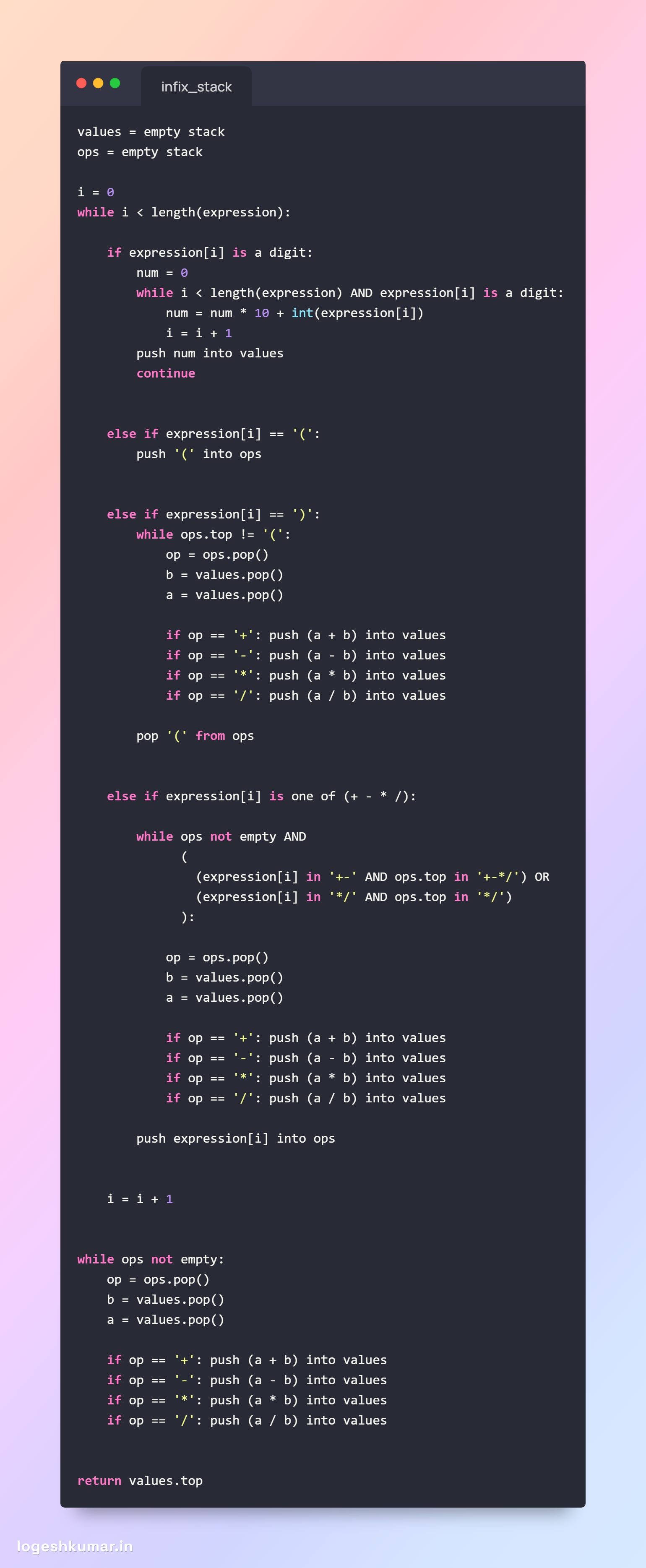
This is where two stacks are used:
one stack for operands
one stack for operators
Rules:
If number → push to operand stack
If
(→ push to operator stackIf
)→ solve until(is foundIf operator:
while top operator has higher or equal precedence
solve it
then push current operator
At the end:
solve remaining operators
2. Postfix
3 5 2 * +Pattern:
Scan from left to right
If operand → push to stack
If operator:
pop two values
apply operator
push result back
At the end:
stack will have one value
that is the answer
Prefix
+ 3 * 5 2Pattern:
Scan from right to left
If operand → push
If operator:
pop two values
apply operator
push result
Same logic, just reversed traversal.
Infix Expression pseudocode
4. Augmented Stack Pattern
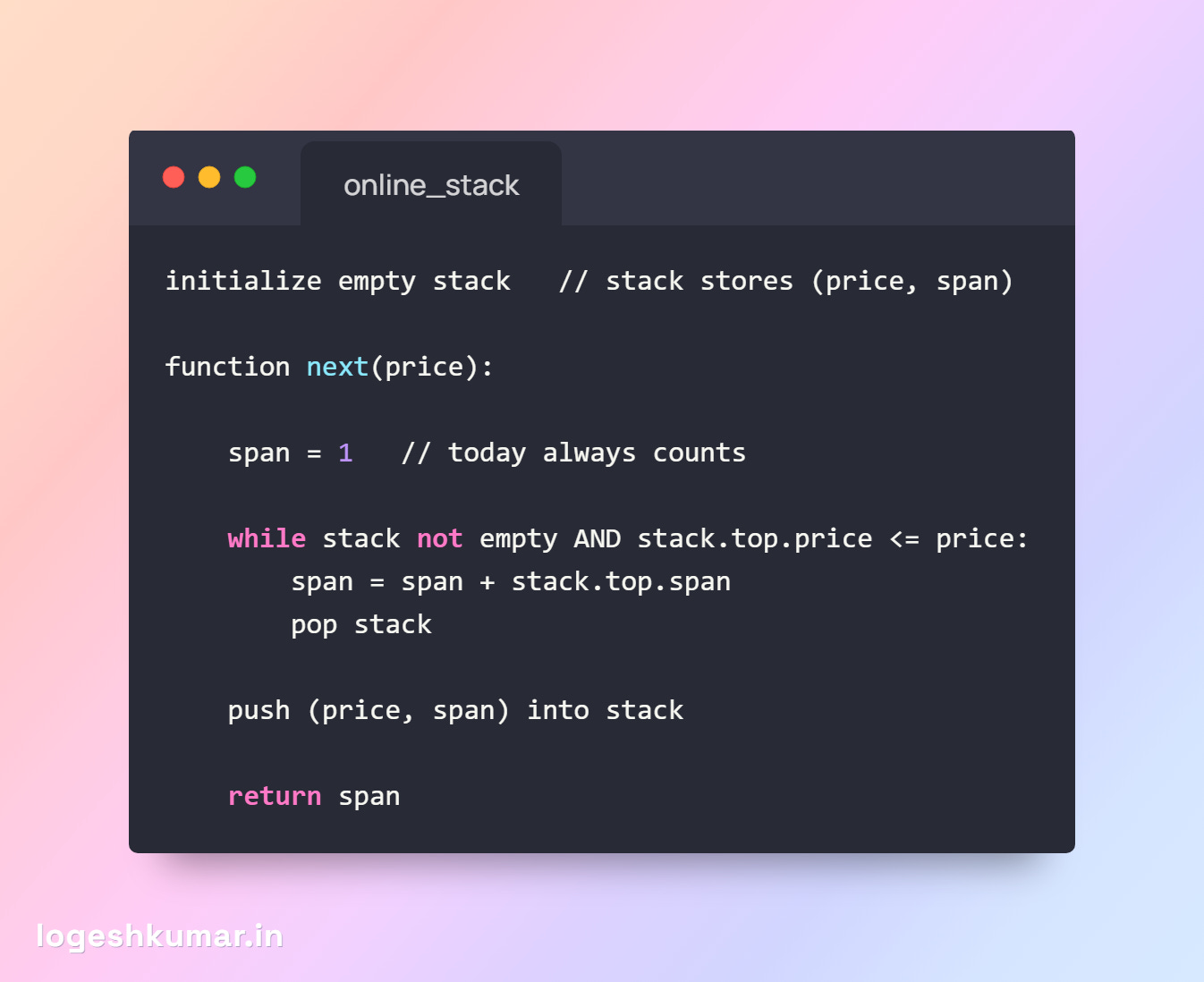
A normal stack where each element carries extra information to avoid recomputation.
For example, let’s take LeetCode 901:
https://leetcode.com/problems/online-stock-span/
The problem is simple:
You are getting stock prices day by day.
For every new price, you want to find the span.
Span means:
How many consecutive days (including today)
the stock price was less than or equal to today’s price.
Input
[”StockSpanner”, “next”, “next”, “next”, “next”, “next”, “next”, “next”]
[[], [100], [80], [60], [70], [60], [75], [85]]

Output
[null, 1, 1, 1, 2, 1, 4, 6]

Explanation
StockSpanner stockSpanner = new StockSpanner();
stockSpanner.next(100); // return 1
stockSpanner.next(80);  // return 1
stockSpanner.next(60);  // return 1
stockSpanner.next(70);  // return 2
stockSpanner.next(60);  // return 1
stockSpanner.next(75);  // return 4, because the last 4 prices (including today’s price of 75) were less than or equal to today’s price.
stockSpanner.next(85);  // return 6
Here the solution needs O(1) time complexity per operation.
So you cannot traverse the array every time
because that will become O(n) per call.
Instead, you must reuse previous results for the next element.
This is exactly where Augmented Stack works.
This problem needs:
Monotonic Stack → to maintain order of prices
Augmented Stack → to store span so we don’t recompute
5 . Simulation Stack Pattern
Simulation is nothing but instead of thinking in pattern think in real world problem how you solve
for example we will take LeetCode 735
https://leetcode.com/problems/asteroid-collision/
The problem is, an array is given like
a = [5, 10, -5]Here we consider each number as an asteroid.
positive number → asteroid moving right
negative number → asteroid moving left
value → size of asteroid
The output will be:
[5, 10]Explanation:
10and-5collide,10survives5and10never collide because both move right
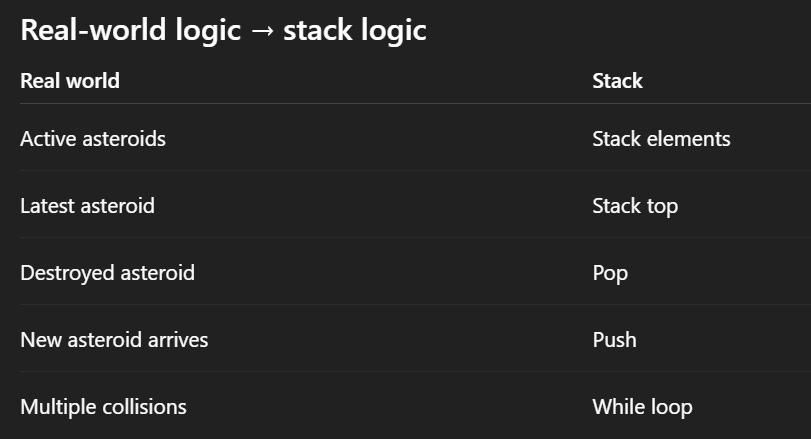
Instead of thinking pattern wise,
if we think problem wise (real world), we can solve it.
Simulation
Asteroids move at the same speed
A collision happens only when:
one asteroid is moving right
and the next asteroid is moving left
When they collide:
bigger one survives
smaller one is destroyed
if same size → both destroyed
A surviving asteroid can collide again with earlier ones
Nothing else happens.
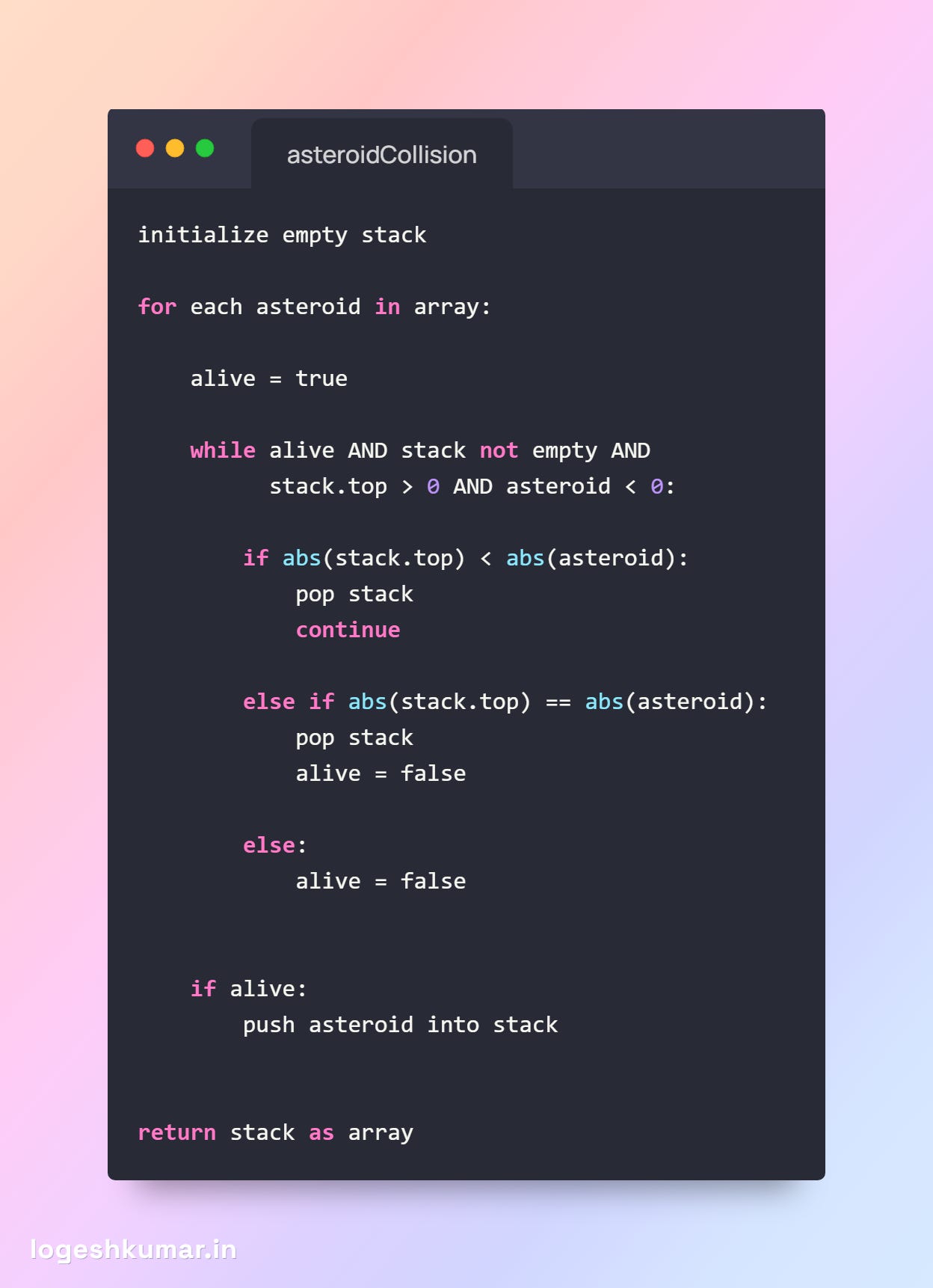
Pseudocode
These are three important patterns you want to practice in stack.
Not because interviewers like patterns,
but because almost every stack problem falls into one of these.
Thank You